
Future Directions for Canadian Trade Policy: A Youth Perspective (Ages 18–24)
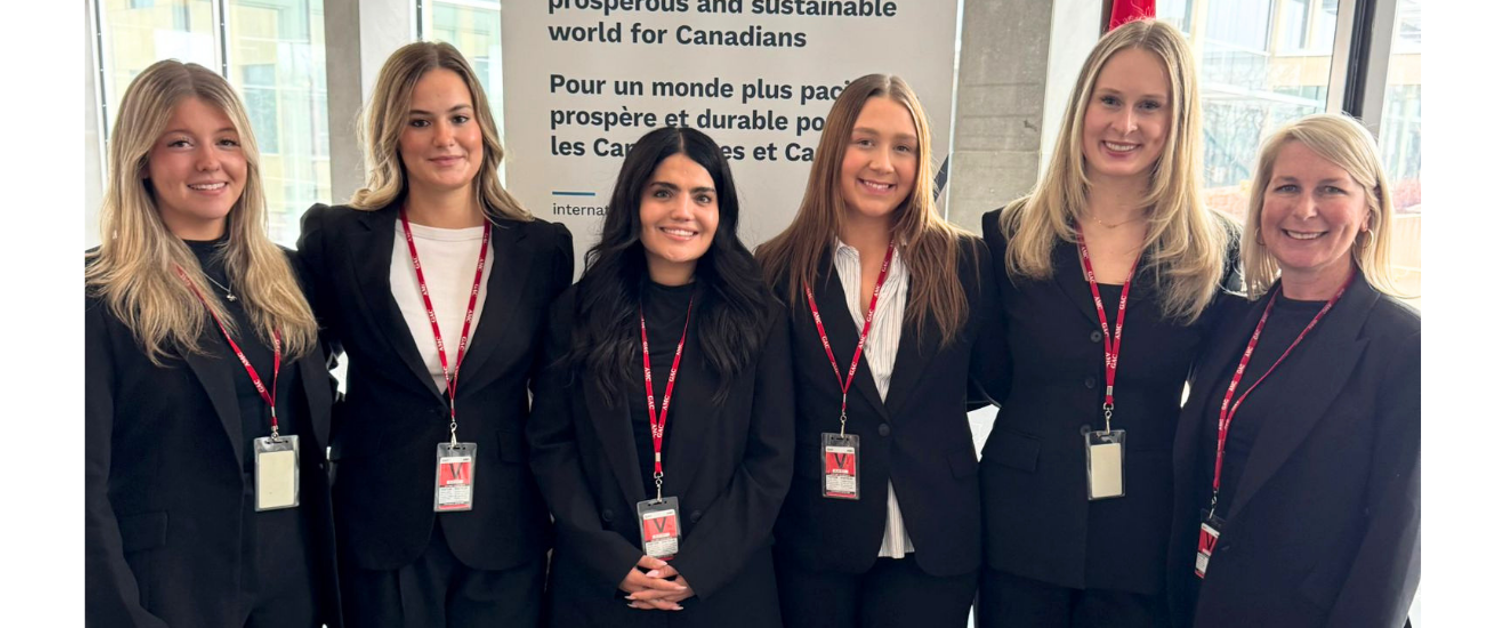
From April 9 to 11, five King’s Politics and International Relations students, Madison Comrie-Dalziel, Tristynn Drohan, Kya Linner, Joan Thompson (student researchers), and Sabrynn Dugsin‑Porchuk (research assistant), travelled to Ottawa to present trade policy recommendations from a youth perspective to senior officials at Global Affairs Canada.
Their work brought the voices of Canadians aged 18–24 directly into federal trade policy conversations, and demonstrated what a King’s education makes possible: undergraduate students engaging decision-makers with rigorous, research-based recommendations.
The Ottawa visit was part of Building Trust in Trade, a Social Sciences and Humanities Research Council of Canada (SSHRC) Insight Grant project that brings together researchers and students from King’s University College, McMaster University, and Purdue University.
Led by Dr. Andrea Lawlor (McMaster) as Principal Investigator, with Dr. Erin Hannah (King’s) and Dr. Tyler Girard (Purdue) as Co-Investigators, the project examines how to rebuild public trust in trade by better aligning trade policy with the priorities of citizens, especially young people. A core component of the grant is student training and mentorship, ensuring that students conduct original research and translate those findings into policy-relevant knowledge mobilization.
King’s students contributed to this work by developing concrete recommendations on key themes shaping the future of Canadian trade policy. They focused on the upcoming review of the Canada-United States-Mexico Agreement (CUSMA), digital trade and artificial intelligence, energy and natural resources, investment, labour protections, gender equality, and the green economy. One recommendation that resonated strongly with officials was the creation of a Youth Advisory Council on trade, designed to institutionalize youth voices in ongoing trade negotiations and reviews.
The visit culminated at Global Affairs Canada, where students presented their research in a formal briefing room to officials working directly on trade policy. They delivered executive briefs, walked officials through their key findings, and responded to questions about feasibility, implementation, and political constraints. Their abstracts and briefs were circulated in advance, which allowed the discussion to move quickly into substantive engagement with their recommendations.
The session was coordinated with the support of King’s alumna Madison Paisley, who works in Canada-EU trade relations at Global Affairs Canada, and reflected a wider openness to youth-informed research within the department.
Preparation for Ottawa began months earlier. Under the supervision of Dr. Hannah, Dr. Lawlor, and Dr. Girard, students moved through each stage of the research process: identifying policy problems, designing research questions, collecting and analyzing data, drafting executive briefs, and refining their presentations.
In the days leading up to the visit, students from King’s, McMaster, and Purdue participated in a mock presentation session where they delivered their talks and received detailed, individual feedback from faculty. They revised overnight and arrived at Global Affairs Canada the next morning with polished, policy-ready presentations—a process that underscored the intensity of the training and the depth of mentorship built into the project.
For the students, presenting to federal officials changed how they understood both trade policy and their own work.
Thompson noted that “we weren’t just talking about trade in the abstract, we were making concrete recommendations to the people who will be involved in the CUSMA review. Seeing officials engage with our Youth Advisory Council proposal made it clear that youth voices can shape policy if they are backed by strong research and clear communication.”
Reflecting on the experience, Linner emphasized how it reshaped her sense of what policy work entails: “This trip broadened my understanding of trade and showed me the power of women in trade, but it also allowed me to fully immerse myself in what high‑level research deliverables look like. Seeing our work taken seriously by officials made the policy world feel tangible and reachable.”
The visit also highlighted the strength of the King’s alumni network in Ottawa. While in the capital, students attended a networking event with King’s Political Science and PIR graduates working in government, law, consulting, and public policy.
Alumni from graduating years dating back to 1995 spoke about their career paths, from policy analyst roles in federal departments, to legal practice, to advisory work in the private sector, and offered concrete advice on graduate school, internships, and early career decisions. For current students, the event reinforced that a King’s education is part of a wider professional community and that alumni are invested in mentoring the next generation.
Beyond the policy briefing, students also engaged with Canada’s broader legal and political institutions, including visits to Parliament and the Supreme Court of Canada. Connecting their research on trade and youth priorities to the institutional landscape of Canadian governance helped situate their policy work within the wider architecture of law, rights, and democratic accountability.
Taken together, the Ottawa visit showcased what a King’s education makes possible. Students conducted original research on questions that matter to Canadians, translated that work into executive briefs and presentations, and delivered their findings directly to federal officials responsible for trade. They did this as part of a nationally funded, international collaboration that embeds intensive mentorship at every stage and connects classroom learning to real policy processes.
“This is what a King’s education looks like. Students build the skills and confidence to conduct original research on questions that matter, translate it into policy-relevant advice, and deliver it directly to decision makers. It reflects King’s distinct value proposition and how we prepare the next generation of policy leaders,” shares Dr. Hannah, Associate Dean of Research and Professor of Politics and International Relations.
Building Trust in Trade will continue to generate research on how trade policy can better reflect public priorities. As partnerships with Global Affairs Canada and the King’s alumni community in Ottawa deepen, King's students will remain at the centre of that work.
Written by Sabrynn Dugsin-Porchuk, 4th Year BA in Politics and International Relations and Research Assistant