
What's The True Cost Of Local Food? King's Professor's Research Inspires Documentary
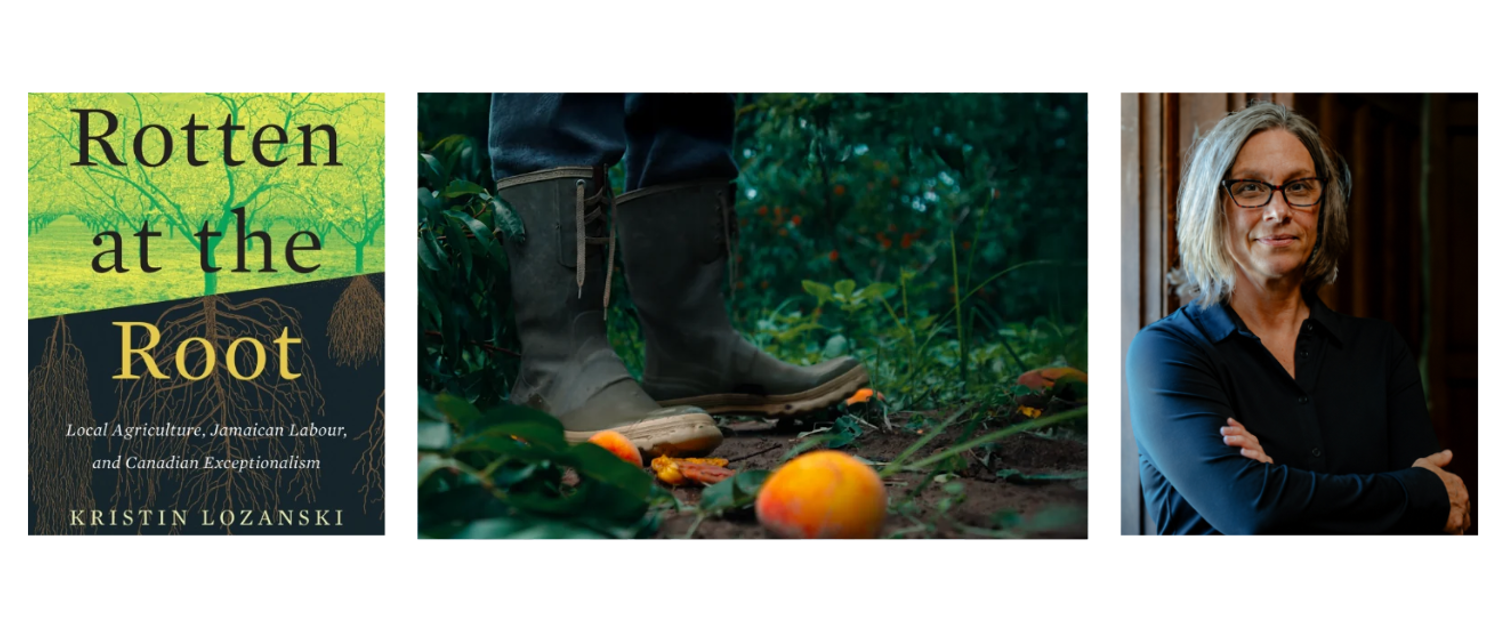
Middle photo credit to Moses Latigo Odida '09.
Dr. Kristin Lozanski is asking Canadians to consider what it takes to put locally grown food on their tables and inviting the public to explore that question at a special event at King’s University College.
Lozanski, a Professor of Sociology at King’s, has spent a decade conducting research with Jamaican farm workers in Niagara. Her new book, Rotten at the Root, inspired a documentary of the same name, created with filmmaker and King’s alumnus Moses Latigo Odida ’09. Screening at King’s on November 26, the film brings her research to a broader audience, including the workers and families whose stories helped shape it.
In Rotten at the Root: Local Agriculture, Jamaican Labour, and Canadian Exceptionalism, Lozanski examines what the seasonal work program means for the people who come to Canada to grow food and for their families in Jamaica. She says researchers have documented problems with workers’ housing and working conditions for at least two decades. One question runs through her book: How have those conditions persisted in a country that takes pride in how it treats people?
Lozanski says the work is also a response to the federal AgriCommunication Initiative and campaigns such as More than a Migrant Worker, which she says give too little attention to workers’ living conditions.
“If you’re meeting the requirements of the program, there’s no guarantee of dignity for the people who participate in the program,” Lozanski says. She talks about migrant workers’ housing where beds are a mere 18 inches apart, or where 10 workers can share one toilet. What that means in practice, she says, becomes clear when all 10 are getting ready for work at six in the morning.
The idea for a documentary came from conversations with workers Lozanski interviewed. They often asked to read her book, and Lozanski started considering how to make the work accessible to everyone affected. She asked Latigo Odida, whom she had known for years, for advice on how to do so. He embraced the idea, travelling with Lozanski to Niagara three times to film the documentary.
“As a documentary filmmaker, I continue to draw on the insights I gained as a King’s student in the SJPS program, particularly the responsibility to document voices from the margins of society,” says Latigo Odida. “This commitment is also deeply rooted in my identity as an African filmmaker and in the philosophy of Ubuntu, which calls on us to recognize our shared humanity and consider whose stories remain unheard. For these reasons, my conversations with Dr. Lozanski about working on a short documentary seemed natural.
“Her work humanizes the often unseen and complex lives of the farmworkers responsible for sustaining our food system. I was drawn to the opportunity to help translate her research into a short documentary.”
One audience Lozanski particularly hopes to reach is in the Jamaican community. Seasonal work in Canada offers higher wages, she says, and families understand its financial value. But when a community sees a place in the program as an opportunity, workers can feel an expectation to be grateful. Some are reluctant to tell people at home about difficult conditions. Lozanski hopes the film opens up a conversation about what taking that opportunity costs workers and their families.
"It’s really important that we think about where our food comes from. We’re living in a time when food insecurity and difficulties in accessing food are on the rise. As part of that broader conversation about what access to food means, we need to think about the people who grow our food and the conditions they live and work in.
"There’s an issue with how we, as Canadians, see ourselves and how we think the world sees us. This has come up in recent international conversation, such as Barack Obama’s remarks about the U.S. picking a fight with ‘nice’ Canadians. This stereotype makes it harder to look honestly at problems in Canada, even when we know they exist."
The screening of Rotten at the Root takes place on Thursday, November 26, at 7 p.m. in the Joanne and Peter Kenny Theatre at King’s University College. The event is free and open to the public, with a panel discussion following the film.