
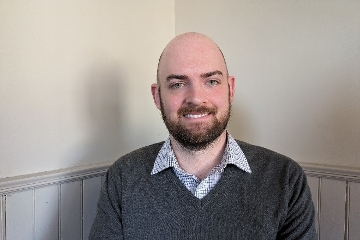

Dr. Joshua Wyman is an Assistant Professor in the Department of Psychology at King’s. His current research examines the prevention, investigation, and response to older adult maltreatment, with a particular focus on investigative interviewing practices, eyewitness memory, and professional law enforcement training. His prior research focused on improving police and forensic interviewing practices with children, youth, and individuals with cognitive impairments.
Dr. Wyman regularly supervises undergraduate thesis students and involves them in his applied research. Recent student projects have examined the characteristics of real-world police interviews involving older adults; the perspectives of law enforcement, health professionals and older adults regarding older adult maltreatment; police practices and training needs for interviewing older adults with cognitive impairments; and adults’ abilities to accurately detect truthful and deceptive statements given by children with developmental disabilities.
Dr. Wyman was recently awarded a Social Sciences and Humanities Research Council (SSHRC) Insight Grant to investigate the experiences of older adults with stigmatized health conditions within the criminal justice system. This research aims to inform evidence-based guidelines and training programs for law enforcement and correctional professionals about reducing the barriers to communicating with older adults about their complex, and sometimes stigmatizing, health needs. Future thesis students may have opportunities to contribute to this research.
Dr. Wyman is a registered school and clinical psychologist in Ontario. At King's, he teaches courses in clinical psychology, mental health and wellness, child mental health and development, and professional clinical practices. He also teaches a fourth-year undergraduate practicum course that provides students with supervised experience in clinical, health, forensic, and community psychology settings.
Education
- PhD., School/Applied Child Psychology, McGill University
- M.A., School/Applied Child Psychology, McGill University
- B.A., Psychology and Criminal Justice, Bethel University
Teaching
- PSYCHOLOGY 1000: Introduction to Psychology
- PSYCHOLOGY 2022: Mental Health & Wellness
- PSYCHOLOGY 2301: Introduction to Clinical Psychology
- PSYCHOLOGY 3320: Child Psychopathology
- PSYCHOLOGY 4692: Practicum
Research
- Investigative interviewing practices and adaptations for older adults with diverse cognitive, socio-emotional and health needs.
- Enhancing eyewitness memory among populations with cognitive impairments
- Development of law enforcement training programs and evidence-based professional resources
- Prevention, identification, and investigative practices in cases of older adult maltreatment
- Deception detection and eyewitness credibility analysis
Research Profile: ResearchGate Profile
Selected Publications
Peer-Reviewed Articles
- Wyman, J., Dion Larivière, C., Tayem, T., & Malloy, L. (2026). Responding to older adult maltreatment: Interdisciplinary geriatric care provider experiences and training needs. Canadian Journal of Nursing Research, 58(3), 398-412. https://doi.org/10.1177/08445621261443833
- McDowell, K., Wyman, J., & Talwar, V. (2026). Mock juror perceptions of eyewitness reports given by children with intellectual disabilities. Journal of Autism & Developmental Disorders, 56, 735-747. https://doi.org/10.1007/s10803-024-06561-6
- Wyman, J., ElSaleh, R., Dion Larivière, C., & Malloy, L. (2025). Canadian law enforcement perceptions of older adult maltreatment, interviewing practices and training needs: A qualitative study. Journal of Police and Criminal Psychology, 40, 212–228. https://doi.org/10.1007/s11896-025-09731-z
- Wyman, J., & Malloy, L. (2024). Increasing disclosures of older adult maltreatment: A review of best practices for interviewing older adult eyewitnesses and victims. Psychiatry, Psychology & Law, 31(2), 274-292. https://doi.org/10.1080/13218719.2023.2192260
- Snow, M. D., Wyman, J., Malloy, L. C., Brubacher, S. P., & Warren, K. L. (2023). Police perspectives on interviewing older adult victims and witnesses: Preliminary findings and call for future research. Journal of Forensic Psychology Research and Practice, 23(5), 438-458. https://doi.org/10.1080/24732850.2022.2044714
- Wyman, J., Tong, D., Foster, I., Crossman, A., & Talwar, V. (2022). The effectiveness of cognitive instructions when children provide true and false eyewitness reports of another’s transgression. Police Practice and Research: An International Journal, 23(3), 290-307. https://doi.org/10.1080/15614263.2021.1954923
- Wyman, J., Cassidy, H., & Talwar, V. (2021). Utilizing the Activation-Decision-Construction-Action Theory to predict children’s hypothetical decisions to deceive. Acta Psychologica, 218, 103339. https://doi.org/10.1016/j.actpsy.2021.103339
- Lavoie, J., Wyman, J., Crossman, A., Talwar, V. (2021). Meta-Analysis of the effects of two interviewing practices on children’s disclosures of sensitive information: Rapport practices and question type. Child Abuse & Neglect. 113, 104930. https://doi.org/10.1016/j.chiabu.2021.104930
- Wyman, J., Saykaly, C., & Talwar, V. (2021). The effectiveness of free-recall, cognitive instruction and closed-ended questions when students with and without disabilities provide eyewitness reports of another’s transgression. Psychology, Crime & Law, 27(9), 849-868. https://doi.org/10.1080/1068316X.2020.1852564
- Wyman, J., & Claro, A. (2020). The UCLA PEERS school-based program: Treatment outcomes for improving social functioning in adolescents and young adults with autism spectrum disorder and those with cognitive deficits. Journal of Autism and Developmental Disorders, 50(6), 1907-1920. https://doi.org/10.1007/s10803-019-03943-z
- Wyman, J., Foster, I., Crossman, A., Colwell, K., & Talwar, V. (2019). The efficacy of free-recall, cognitive load, and closed-ended questions when children are asked to falsely testify about a crime. Applied Cognitive Psychology, 33(4), 544-560. https://doi.org/10.1002/acp.3494
- Wyman, J., Lavoie, J., & Talwar, V. (2018). Best practices for interviewing children with intellectual disabilities in maltreatment cases. Exceptionality, 27(3), 167-184. https://doi.org/10.1080/09362835.2018.1425623
- Wyman, J., Foster, I., Lavoie, J., Tong, D., & Talwar, V. (2018). Detecting children’s false allegations and recantations of a crime. Psychology, Crime & Law, 24(6), 652-671. https://doi.org/10.1080/1068316X.2017.1402018
Book Chapters
- Wyman, J., Dianiska, R., Henderson, H., & Malloy, L.C. (2023). Adolescent victims and witnesses: Disclosures, memory, and suggestibility. In A. Redlich & J. Quas (Eds.), The Oxford Handbook of Developmental Psychology and the Law (pp. 233-256). https://doi.org/10.1093/oxfordhb/9780197549513.013.12
- Malloy, L., Wyman, J., Mukhopadhyay, S., & Quas, J.A. (2023). Legal decision making among youth defendants, victims, and witnesses: Emerging issues, research, and theory. In D. DeMatteo & K. Scherr (Eds.), The Oxford Handbook of Psychology and Law (pp. 510-526). Oxford University Press. https://doi.org/10.1093/oxfordhb/9780197649138.013.30